
Within Reach, Out of Grasp
News vom 27.10.2026
Energy Landscapes Between Habitat, Protected Area and Restricted Access – a Workshop Report
Mathilde Stangenberger
Two orange numbers stand at the edge of a swath that is cut through the forest like a corridor. They are the only signs that something lies beneath our feet that we can neither touch nor see: the Drushba oil pipeline running from Almetyevsk all the way to Schwedt/Oder, where we are standing on this sunny Tuesday in October as part of the Energy Landscapes Travel Workshop. How do you make infrastructures tangible when you can neither see nor touch them? What do we even talk about when we speak of energy landscapes? And how do landscapes transform when they are altered for the purpose of energy extraction? These questions accompanied us throughout the workshop to Schwedt and Greifswald.
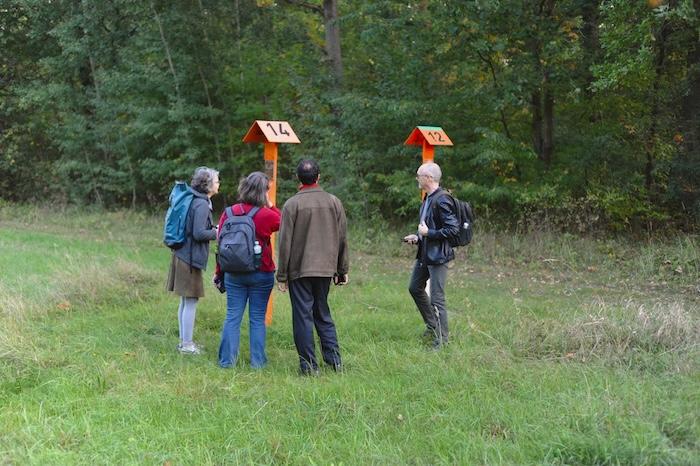
Signs of Drushba. Photo: Mathilde Stangenberger
The day before, in Berlin, some things were still lying on the table, touchable and within reach: a fragment of nickel, a postage stamp. As part of the first day, all participants showed an object or material that stood in relation to their research and the topic of the workshop. The event, organized by the Research Group (Susanne Strätling) in cooperation with Ksenia Litvinenko (IRS) and Roman Dubasevych (Greifswald University/IFZO), brought together researchers and energy enthusiasts from Prague, Zurich, Greifswald, El Paso, Stockholm, Basel, Glasgow, and Berlin. The opening session gave each participant the possibility to present their research interests within this field, providing an overview of the heterogeneous, yet continuously connected topics. Immediately after the introductory session, the travelling part of the workshop began with a train ride to Schwedt.
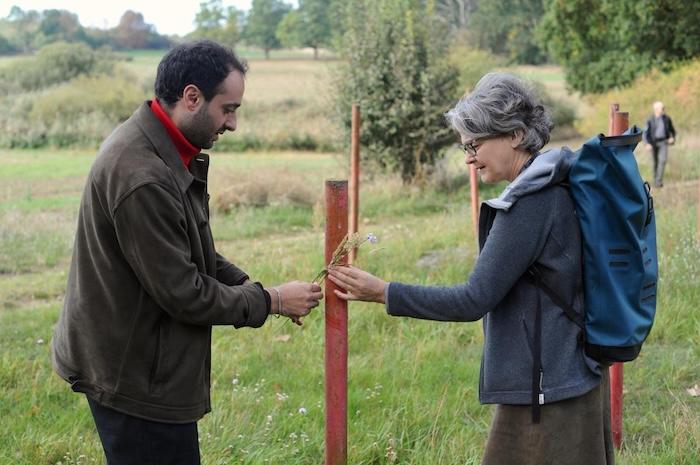
Walking Drushba with Gabriyel Dari. Photo: Mathilde Stangenberger
The next morning, we stepped into the landscapes that we talked about the day before. Gabriyel Dari, an architect based in Zurich, let us participate in what he himself experienced in 2023: Collectively, we walked along a part of the Drushba pipeline that he hiked from Schwedt to the Polish-Belarusian border as part of his master’s thesis. Next to the small signs hinting at the Drushba beneath our feet, the natural surroundings also provided many intriguing aspects to discover (butter mushrooms, for example). The markers we used to guide our way served as a sort of hiking trail, a path that we followed continuously. Gabriyel invited us to actively scan our environment and accompanied his tour with quotes along the way.
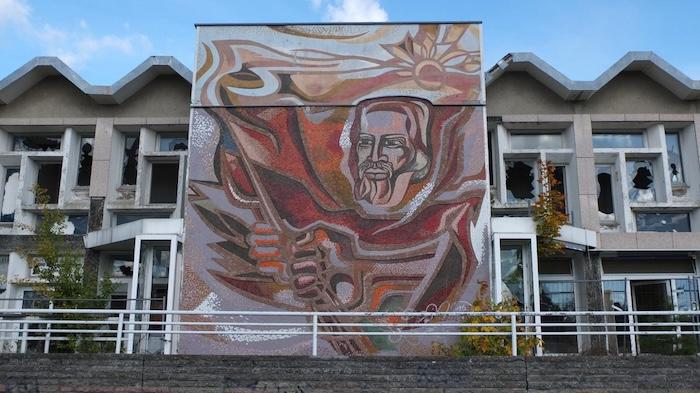
Wall mosaic at Uckermark Passagen showing Friedrich Engels, by Herdegen Fehlhaber and Werner Voigt, 1971–76. Photo: Susanne Strätling
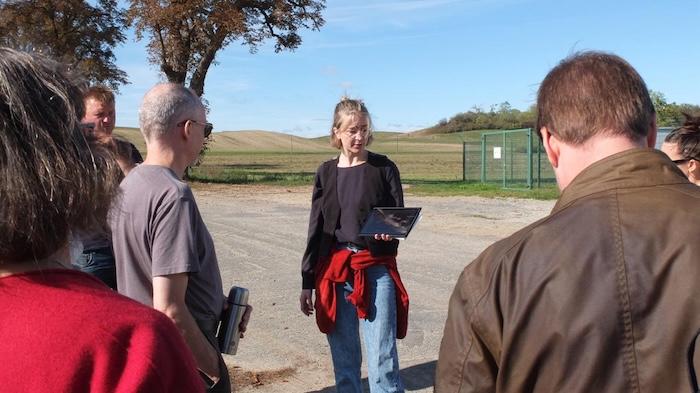
City tour with Lea Marie Nienhoff. Photo: Susanne Strätling
The walk ended at a valve station, where we had a quick picnic and continued the walking theme together with Lea Marie Nienhoff, cultural advisor at the city of Frankfurt (Oder), leading us through the cultural landscape of Schwedt. Lea was accompanied by her friend Stefan, who works at the PCK refinery and grew up in the town, thus providing us with valuable memories. The first stop of the tour was the Uckermark Passagen, an abandoned shopping centre that once housed a school cafeteria. The building is now privately owned and visibly falling into disrepair – as are the barracks where workers were housed during the construction of the PCK, which we visited right after. Back in the day, this complex included a cultural centre with a discotheque, in front of which nowadays no one queues anymore. A few blue trash bags are all that is left.
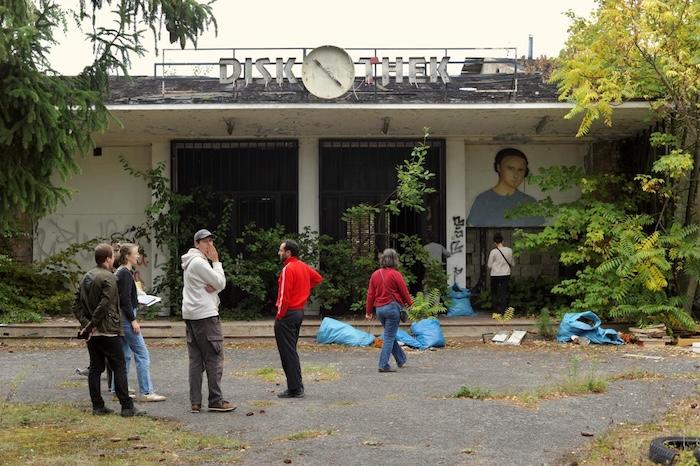
Discotheque at the former cultural center. Photo: Mathilde Stangenberger
As a finale of the city tour, we climbed the 170 steps of the steeple at St. Katharinen Church, from where we had a view not only of the PCK refinery but also of the Lower Oder Valley National Park, located east of the city, which is home to a particularly rich variety of species. Here, the city’s contrasts felt very tangible: the oil refinery on one side, the national park on the other.
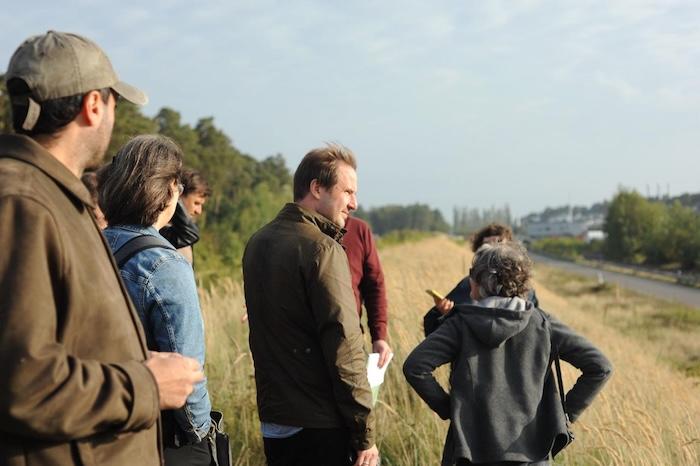
Overlooking Lubmin Industrial District. Photo: Mathilde Stangenberger
The same afternoon, we hopped on a regional train to Greifswald, where the next events on the itinerary were waiting for us the following day. Standing on a dike overlooking the Lubmin industrial district, Evgeni Shoifet from Deutsche Ölwerke gave us an overview of the area with the Nord Stream landing station, the new “Deutsche Ostsee” LNG terminal, the OPAL pipeline header station and the Bruno Leuschner Power Plant, which we were able to tour afterwards. Eckhard Skaebe, a former employee at the nuclear power plant and later involved in its decommissioning, led us through the imposing facility characterized by massive concrete structures and pipes. He explained the technical details and history of the plant and also provided vivid insights into everyday work life back when it was still running. Here, too, the theme of the invisibility of the actual – nuclear – energy was very much present.
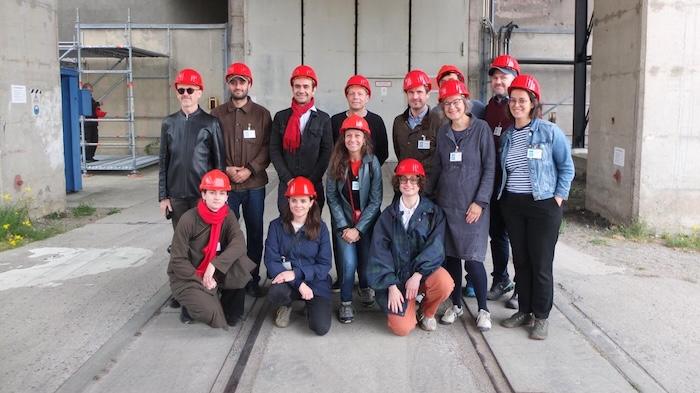
Visit to the Bruno Leuschner Power Plant. Photo: unknown guests at Bruno Leuschner
Our workshop came to a fitting conclusion with a visit to the Interdisciplinary Research Centre for Baltic Sea Region Research (IFZO) in Greifswald, where we listened to presentations on the centre’s current research projects, ranging from peatlands to oil-contaminated landscapes. Afterwards, we held a brief closing session, during which each participant presented material collected during the workshop: from images and sound bites to tactile and tangible objects such as seashells and pinecones. In particular, the personal and emotional connections that the locals showed in relation to the energy infrastructures in Schwedt and Greifswald/Lubmin left a lasting impression on us. What seemed to unite the group was the question of how to grasp these infrastructures, how the distance created by the intangibility as well as the partial inability to read these landscapes can be overcome, and whether it should be.
Filled with many impressions, we went back to Berlin through a grey and rainy October landscape the next morning. From the train window, in the fields and meadows passing by, we saw signs of energy infrastructures left and right.


